Facilitators and coordinators
Sort by topic
The Beit Midrash Prayer
Lesson plan
Designed for:
Teachers, pre-military preparatory schools, seminaries, communities
- carrier: Memizrach Shemesh
The Beit Midrash is the space where Torah study and the encounter between those who study it take place. There are different styles and modes of Torah study that reflect the purpose of the study in the eyes of the students. Study aimed at knowledge will be conducted in a different way than study aimed at the observance of the Torah, and study that takes place in a group is different from study by an individual. In many Beit Midrash throughout Jewish history, a preference has been created for study whose ultimate goal is knowledge. Such study may invite competition between the students, who knows more and who knows less, and create motivation for learning built on satisfying the 'I' and self-respect. This preference is opposed by the fact that in the Jewish Beit Midrash, students study in a group, in which the system of connections and hierarchy within it is dynamic and changing. Placing the group at the center of study, not as a product of chance or as a necessity of reality, offers an opportunity to release the tension that study aimed at knowledge may create and to transform study into a process that requires a personal process of inclusive and caring relationships between people. A process that will strengthen the influence and relevance of the Torah that will emerge from the Beit Midrash to the society outside of it.
The role of parents in educating their children
Lesson plan
Designed for:
Seminaries, communities
- carrier: Memizrach Shemesh
The education system expects parental involvement and sees this involvement as a condition for the success of the educational process. This involvement should be expressed, in the perception of the school, in certain actions such as participation in parent meetings and school activities, representation on the class committee, continuous contact with teachers, etc. An education system may create a situation in which parents from economically and class-disadvantaged social strata are perceived by society and the education system as parents who are not caring and involved enough in their children's education because they are often not active in this way. A deep and sensitive examination of the difficulty of these parents can reveal that it does not stem from a lack of interest or unwillingness to be involved, but from the way in which the education system measures parental care and involvement. The judicial conduct towards them labels, weakens, and excludes these parents in a way that does not allow them to make their voice heard, and creates in them alienation from the system and avoidance of involvement and sometimes even aggression towards it. The school has a significant role in education, but parents have a more crucial role in educating their children. The foundation for education and learning is built at home. Respectful treatment of the educational foundation provided by the home, every home, without labeling of economic or class status will enable cooperation and prevent further weakening of parents. Respectful treatment depends on the ability to listen to these parents, to open up to the culture and language they bring with them, and to the ways in which they express themselves.

Activities for IDF Martyrs' Memorial Day
Lesson plan
Designed for:
Middle school, seminaries
- carrier: Israeli Jewry, leaf
An activity set for IDF Martyrs' Memorial Day. The activity is intended for students immigrating from France. The set includes an opening activity, a study section, and questions for discussion. In addition, you can find ideas for community or school activities on the subject.
Holocaust and Heroism Day activities
Lesson plan
Designed for:
Middle school, seminaries
- carrier: Israeli Jewry, leaf
An activity set for Holocaust and Heroism Day. The activity is intended for middle school students who immigrated from France. The set includes an opening activity, questions for discussion, a reading passage, and suggestions for community activities.
A tool for observation and feedback
activation
Designed for:
Teachers
- carrier: Mesharim
A tool to assist in identity-based pedagogy. For use by the teacher or educational team in planning, observation, and reflection processes.
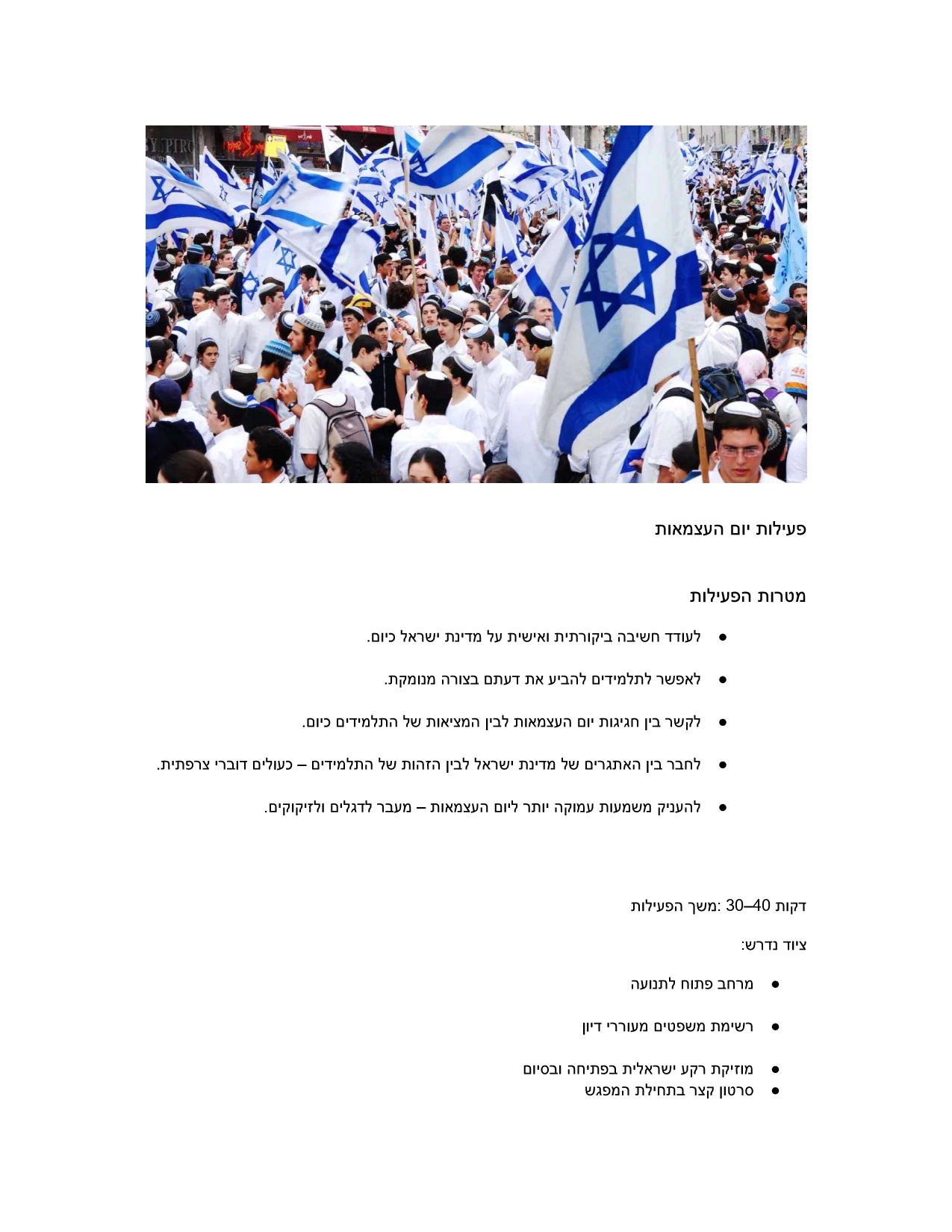
Independence Day Activities – Hebrew and French
Lesson plan
Designed for:
Middle school, seminaries
- carrier: Israeli Jewry, leaf
Independence Day activity set. The activity is intended for students immigrating from France and includes an opening activity, discussion questions, and a concluding quiz. This set has a Hebrew and French version.